Traumatic brain injury cases are among the most complicated cases a personal injury lawyer can handle. The reason is not simply that the medicine is difficult. It is that almost every important part of the case presents its own challenge: understanding how the brain was injured, identifying what changed afterward, connecting those changes to the injury, and ultimately explaining all of it in a way that ordinary people can understand.
The human brain is extraordinarily complicated. It contains billions of nerve cells communicating through enormous networks, and different regions participate in memory, attention, vision, balance, language, emotion, judgment, behavior, and countless other functions. Those systems do not operate independently. They communicate constantly with one another.
When trauma disrupts those systems, the consequences can be equally complicated.[1]
The injury may be invisible
One of the first difficulties is that a person can suffer a concussion or mild traumatic brain injury without having an abnormal CT scan or conventional MRI.
That can be confusing. We are accustomed to injuries we can see. A broken leg appears on an X-ray. A torn ligament may appear on an MRI. A surgical incision can be photographed.
Brain injury is different. Concussion can involve changes in the way brain cells communicate, produce and use energy, regulate blood flow, and transmit information without producing an obvious structural abnormality on conventional imaging. But these changes cannot be seen because the damaged brain cells are microscopic in size.
That creates one of the central challenges in brain injury litigation: How do you prove an injury that may not be visible?
The answer requires looking beyond a single medical test. The lawyer must understand the mechanism of injury, medical history, symptoms, neurological findings, cognitive testing, treatment, and perhaps most importantly, the difference between the person’s functioning before and after the event. That same lawyer must know and understand how to present witnesses who can speak to what the injured person was like before and after the injury. That sort if testimony is critical to the success of a brain injury claim or trial.
The symptoms can seem unrelated
Brain injury can also produce an unusually broad collection of symptoms.
- A person may experience headaches, dizziness, balance problems, light or noise sensitivity, memory difficulty, slowed thinking, poor concentration, sleep disturbance, fatigue, anxiety, irritability, depression, visual problems, or changes in personality and behavior.
To someone unfamiliar with brain injury, these can appear to be separate and unrelated complaints. Why would the same injury cause headaches, memory problems, difficulty sleeping, irritability, and an inability to tolerate a crowded grocery store?
Understanding the answer requires understanding how interconnected the brain really is. Injury to one system can affect another, and several disrupted systems may produce symptoms simultaneously.
That complexity can make these cases especially vulnerable to misunderstanding.
Seeing a lawyer soon after your injury is advisable.
The Statute of Limitations: You generally have two years from the date of the injury to file a traumatic brain injury (TBI) lawsuit under CPRC § 16.003CPRC § 16.003
The person may look perfectly normal
Perhaps one of the greatest challenges is that many people with brain injuries do not look injured.
They may walk normally, speak clearly, dress appropriately, recognize everyone around them, and carry on an intelligent conversation. A juror may understandably wonder: Where is the brain injury?
But being able to have a 20-minute conversation is very different from functioning effectively throughout an eight-hour workday. Someone may be able to answer questions in a doctor’s office but struggle to multitask, remember instructions, tolerate noise, organize complicated tasks, control emotions, or maintain concentration for extended periods.
That distinction can be enormously important. And make no mistake, insurance company lawyers know how to use that to their advantage.
Brain injury is often revealed not by what a person can do once, but by what that person can no longer do consistently and reliably over time.[2]
The injury lawyer has to understand the medicine
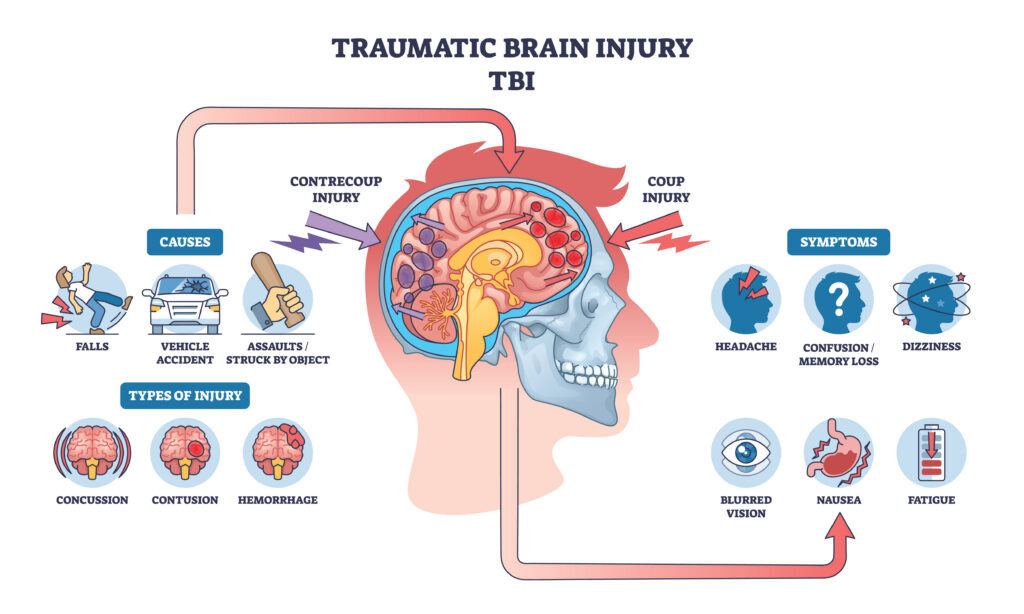
A lawyer does not need to become a neurologist, but a lawyer handling significant brain injury cases needs a working understanding of the brain.
That means learning unfamiliar terminology and understanding structures such as the frontal and temporal lobes, hippocampus, amygdala, cerebellum, brainstem, and the networks connecting them. It also means understanding concepts such as axonal injury, neuroinflammation, altered cerebral blood flow, metabolic dysfunction, executive functioning, neuropsychological testing, and neuroplasticity.
The lawyer must also understand the different medical specialists who may become involved. Neurologists, physiatrists, neuropsychologists, psychiatrists, neuro-ophthalmologists, vestibular specialists, therapists, and rehabilitation professionals may each see a different piece of the same injury.
Knowing how those pieces fit together takes experience.
But understanding complexity is only half the job
There is an interesting paradox in trying brain injury cases: the lawyer must understand the complexity, but the jury should not have to struggle with it.
A trial is not a medical-school lecture. If jurors become buried beneath anatomical terminology, neurological pathways, diagnostic classifications, and complicated medical explanations, they can lose the larger story. Once that happens, even good medical evidence can become ineffective.
The lawyer’s job is therefore not merely to learn the science. It is to translate it. For the lawyer, that takes skill and experience.
That may require diagrams, medical illustrations, animations, models, timelines, demonstrations, or comparisons to things people already understand. Metaphors and analogies that take an unfamiliar neurological concept and connect it to an everyday experience.
Think about trying to explain a disrupted brain network. We can talk about axons, neural connectivity, and impaired communication between brain regions—or we can first ask someone to imagine a city’s communication system after a major storm. The buildings may still be standing, but damaged power lines and interrupted connections can prevent different parts of the city from communicating normally.
The analogy does not replace the science. It creates a doorway to understanding the science.
Simplifying the complexity
- Neurologic Causation: Proving the direct link between the trauma and cognitive, emotional, or physical deficits requires specialized expert testimony (neurologists, neuropsychologists, and life care planners).
- Hidden Damages: Mild TBIs or concussions often do not show up on standard CT scans, requiring advanced diagnostics like specialized MRIs, tensor imaging, or detailed neuro-cognitive testing.
- Recoverable Compensation: Claims cover past and future medical care, specialized rehabilitation, lost wages, diminished earning capacity, pain and suffering, and loss of enjoyment of life.
At Charlie Waters Law, brain injury litigation represents a significant part of what we do. Years of handling these cases have taught me that understanding the medicine is essential—but understanding how to communicate the medicine may be equally important.
The lawyer has to know the science well enough to decide what matters, what does not, and how the important parts fit together. Then comes the harder task: removing unnecessary complexity without sacrificing accuracy.
That requires experience, preparation, creativity, and sometimes a good metaphor.
Because ultimately, the objective is not to turn twelve jurors into neuroscientists. It is to understand the complexity well enough that they don’t have to.
That, to me, is the art of trying a brain injury case.
Stay safe out there!
By Charlie Waters
Dallas Brain Injury Lawyer
Sources:
- Krishnakumar M. Unveiling the Complexity of Traumatic Brain Injury: Insights from Clinical Scoring Systems. Indian J Crit Care Med 2024;28(3):193–195.
- Krishnakumar M. Unveiling the Complexity of Traumatic Brain Injury: Insights from Clinical Scoring Systems. Indian J Crit Care Med 2024;28(3):193–195.
- Texas Constitution and Law, Civil Practice and Remedies Code.
- Texas Constitution and Law, Civil Practice and Remedies Code, Chapter 4.
Questions:
- What if my injured spouse refuses to see a brain injury lawyer? Do I need to see one? Absolutely. Brain injuries can affect a person’s judgment, reasoning, self-awareness, and ability to recognize changes in their own behavior or cognitive functioning. Family members are often the first to recognize these changes, even when the injured person insists that nothing is wrong. Consulting an experienced brain injury attorney can help you understand your spouse’s legal rights, the potential consequences of the injury, and what steps may be available to protect their interests.
- If my spouse has a brain injury and is not able to make decisions, what can I do? A brain injury can impair a person’s judgment and ability to make important medical, financial, or legal decisions. Depending on the circumstances, you may be able to act through a power of attorney or seek court-appointed guardianship. An experienced brain injury attorney can explain your options, help protect your spouse’s legal rights, and pursue compensation for their injuries.